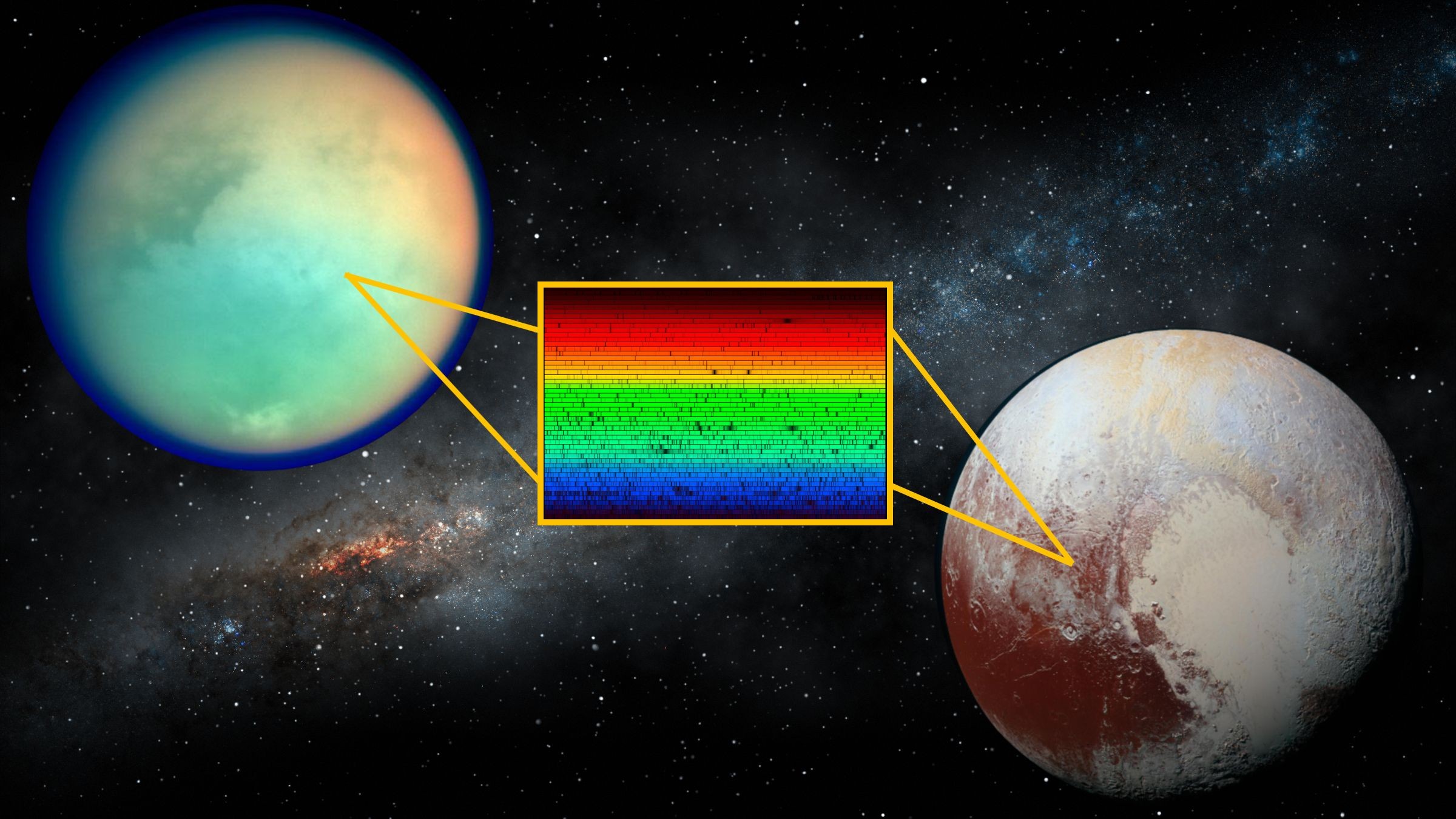
There’s something wrong with the light. Or rather, something is missing. The James Webb Space Telescope looked at Pluto. It looked at Titan, Saturn’s giant moon. Both worlds have a specific gap in their reflection. A dark spot in the spectrum where it shouldn’t be.
The missing light points to a molecule that exists nowhere else we’ve looked. Not in other solar system rocks. Not on distant exoplanets. Nowhere.
Every element has a signature. It eats specific colors of light. Oxygen drinks at 230 naneters. If you see a bite mark at that frequency in an alien planet’s glow, you know oxygen is there. Simple physics. It’s how we peek inside clouds we’ll never visit. Webb is the king of this. It stares into galaxies. It tastes the air of dead stars. It even sniffed out hints of life elsewhere.
Now it’s stuck.
A paper uploaded to arXiv in June details the trouble. Researchers sifted through old data, focusing on tiny wavelengths we’ve mostly ignored. They found the hole. It’s sitting pretty at 5.11 micimeters.
The team checked their textbooks. They checked previous papers. Nothing fit. “Did not find any band… that corresponds to the observed absorption,” they wrote. Flat out. Nothing matched.
Worlds Apart, Yet Together
It makes no sense. Think about Pluto. Then think about Titan. They are cousins, sure, but barely. Titan is massive, bigger than Mercury, swimming in lakes of liquid hydrocarbon. It’s a messy, wet place. Pluto? Pluto is a frozen block of ice. It’s tiny compared to Titan. It’s lonely and far out in the dark.
Both have methane and nitrogen air, sure. But this mystery ingredient isn’t floating around. The data suggests it’s baked into the surface.
On Pluto, the signal is three times stronger than on Titan. More mystery goo on the dwarf planet, apparently. On Titan, it’s patchy. The “trailing side”—the back end of the moon as it circles Saturn—has more of it. The leading side is cleaner.
Why? Maybe it’s benzene mixed with something weird. Maybe acetylene ice. Or ketene. The researchers threw a few guesses into the ring. Benzene, at least, has a ring shape that feels familiar in chemistry. But none of them fit the bill perfectly yet. It’s just a list of suspects with no fingerprints.
So we wait. NASA is sending a helicopter to Titan. Dragonfly. Launch isn’t until at least 2028. It won’t even arrive in the atmosphere until 2034. A long time. That craft will fly right through the smog and analyze the ground directly. Maybe it’ll identify the phantom molecule then.
Will it also explain Pluto? Maybe. The physics might link them. But for now, the universe keeps its secrets.
We’re left staring at a hole in the light and wondering what’s hiding in the shadows.
Will we ever know? 🌌