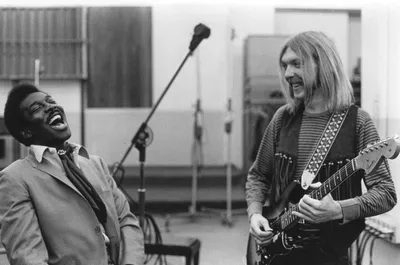
Wilson Pickett didn’t just sing soul music. He testified in it. Born in Prattville, Alabama, on March 18, 1941, Pickett brought the raw, unfiltered power of the Southern Black church to the secular charts. He wasn’t interested in crooning. He preached. His delivery carried the weight of religious conviction, turning every love song into a sermon.
“I’m not a smooth singer. I’m a cornbread singer. I call a cornbread singer [someone] with that rough voice that comes from the stomach, not from the throat.”
This gritty, guttural style became his trademark. It was a voice forged in the church, shaped by gospel, and refined for the rhythm-and-blues stage. When he died in Reston, Virginia, on January 19, 2006, the music world lost one of its most potent voices. But the energy he poured into records like “In the Midnight Hour” remains undeniable.
From Detroit Gospel Roots to the Falcons
Pickett was one of eleven children. Like thousands of other Southern farmworkers, his family migrated north in the 1950s, settling in industrial Detroit where his father worked in an auto plant. There, the gospel roots ran deep. His first recording experiences were purely spiritual. He sang with groups like the Violinaires and the Spiritual Five.
He modeled his approach after Julius Cheeks of the Sensational Nightingales. Cheeks was a thunderous shouter. Pickett adopted that intensity. He didn’t just hit notes. He attacked them. This background in gospel provided the technical foundation for his explosive secular career.
The Wicked Pickett and the Birth of a Hit
The switch to secular music happened fast. As the lead singer for the Falcons, a hardcore rhythm-and-blues vocal group, Pickett co-wrote “I Found a Love” in 1962. That track caught the ear of Atlantic Records producer Jerry Wexler.
Wexler saw something dangerous in Pickett’s voice. He nicknamed him “the Wicked Pickett.” He sent him to Memphis, Tennessee, to write with Steve Cropper. Cropper was Otis Redding’s collaborator and guitarist for Booker T. and the MG’s. The chemistry was instant. The result was “In the Midnight Hour” in 1965.
It was a smash. From that moment, Pickett was a star. He had the looks. He had the confidence. He became a leading figure in the Southern-fried school of soul singing. His unadorned, straight-from-the-gut approach resonated with a civil-rights-minded pop culture. People didn’t just hear him. They felt him.
Muscle Shoals Magic and Philadelphia Polishing
After the Memphis hit, Pickett moved to Muscle Shoals, Alabama, to record at FAME Studios. This period produced his biggest anthems. “Land of 1000 Dances” (1966) and “Mustang Sally” (1966) became staples. “Funky Broadway” followed in 1967. These tracks were raw. They were urgent. They defined an era.
Later, he moved to Philadelphia, working with producers Kenny Gamble and Leon Huff. They took a bit of the edge off his fiery style. The result on tracks like “Engine Number 9” (1970) and “Don’t Let the Green Grass Fool You” (1971) was smoother. It was more polished. Before leaving Atlantic Records, Pickett still had massive hits. “Don’t Knock My Love” (1971), “Call My Name, I’ll Be There” (1971), and “Fire and Water” (1972) kept him at the top of the charts.
Decline, Revival, and Legacy
The rise of funk bands and disco in the late 1970s changed the landscape. Pickett’s popularity dipped. He released “Groove City” in 1979 for EMI. It was his nod to disco. Some critics call it a dance groove of monumental stature. Most of the industry had moved on.
Pickett kept performing into the early 21st century. His influence didn’t fade. Younger singers like Johnny Gill and Jonny Lang cited him as a major inspiration. The vocal power he championed remained a benchmark.
In 1991, he was inducted into the Rock and Roll Hall of Fame. He received five Grammy nominations over his career. These included nods for “In the Midnight Hour,” “Funky Broadway,” and his final album, It’s Harder Now (1999).
His impact was cemented posthumously. In 2016, the U.S. Library of Congress added “In the Midnight Hour” to the National Recording Registry. It was deemed culturally, historically, and aesthetically significant.
Pickett died of a heart attack at age 64. But the cornbread voice still echoes. You hear it in the shout. You hear it in the strain. You hear it in every soul singer who decided that smooth wasn’t enough. The history of soul music is full of voices. Pickett’s is the one that cracks with truth.